The consortium of the European project Interreg Sudoe RuralSilverHubS meets in Burgos
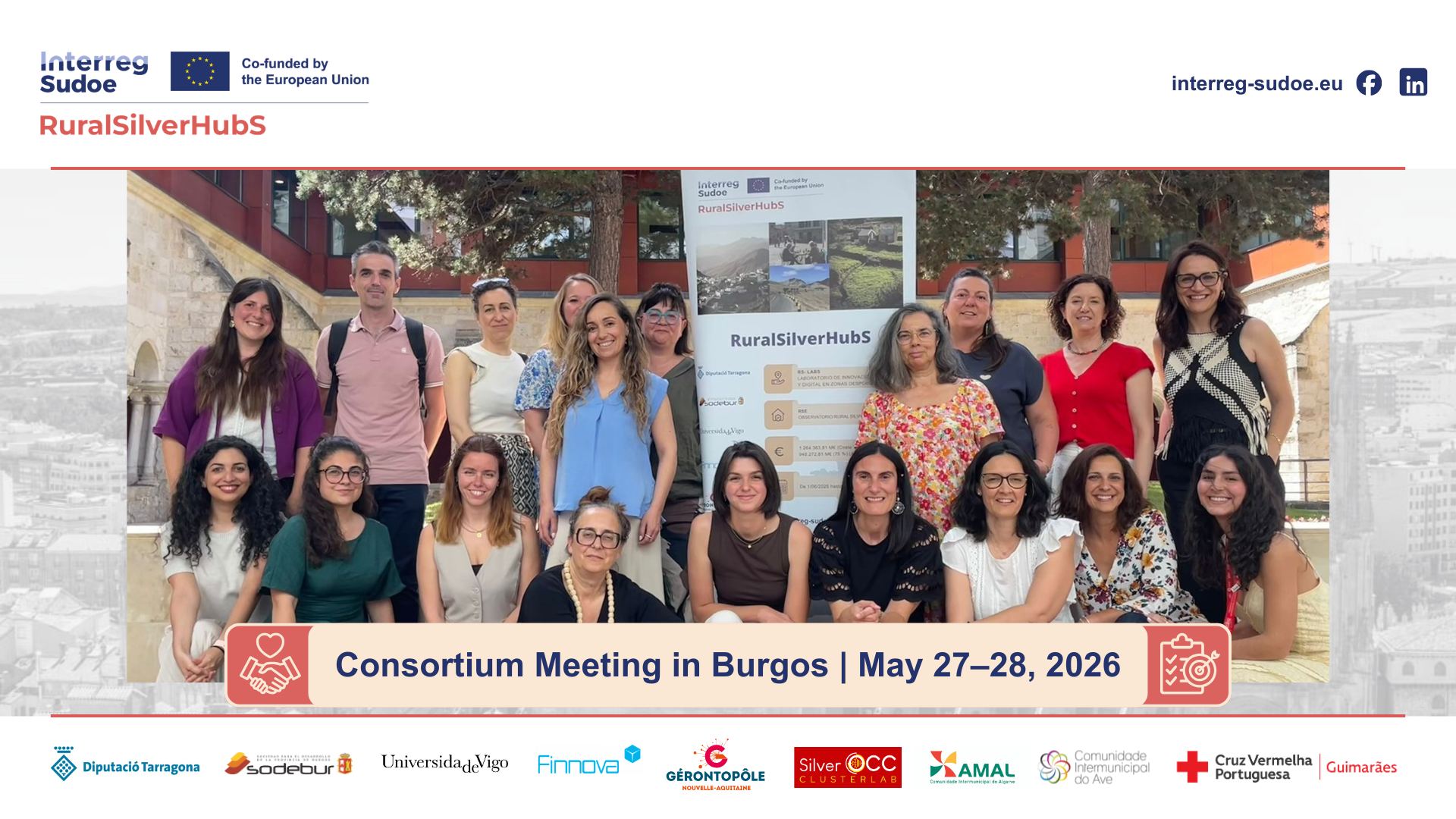
The Royal Monastery of San Agustín hosts a strategic meeting to advance innovative solutions addressing aging and rural depopulation
The project partners highlight the potential of the silver economy as a driver for territorial development, employment, and social innovation in the Sudoe area
Burgos, May 27, 2026
The Royal Monastery of San Agustín in Burgos is hosting this week the consortium meeting of the European project Interreg Sudoe RuralSilverHubS, an initiative that aims to respond to three major common challenges in the Sudoe area: population aging, rural depopulation, and difficulties in accessing specific services in rural environments.
The project focuses on the population growth of people over 55 in rural areas, understanding this phenomenon not only as a demographic and social challenge, but also as an opportunity to generate employment, economic activity, and territorial innovation linked to the silver economy. RuralSilverHubS is committed to placing people at the center of rural transformation, promoting their active participation in decision-making, the valorization of local resources, and the strengthening of rural communities.
Among the main planned actions, key highlights include the creation of the Social and Digital Innovation Labs in Depopulated Rural Environments (RS-Labs) and the development of the Rural Silver Economy Observatory (RSE), tools designed to identify needs, share best practices, and promote innovative solutions in the participating territories.
The meeting, organized by the Society for the Development of the Province of Burgos (SODEBUR), began on May 27 with the institutional participation of Carlos Gallo, President of the Board of Directors of SODEBUR and provincial deputy, who addressed the media interested in the project, and Ricardo Pizarro, director of the entity.
During the meeting, the 16 participants, representing the nine beneficiary entities of the project, highlighted the potential of the silver economy to generate new opportunities in rural areas. In this regard, Carlos Gallo emphasized that it is “an economy that can structure the territory, generate opportunities, and create jobs.”
The meeting served to reaffirm the importance of the project for the participating territories, as they all share challenges related to population aging and the depopulation of rural areas. Furthermore, it was highlighted that this initiative drives innovative solutions for rural areas and fosters cooperation between territories with common challenges.
During the working sessions, the results of the project's first actions were presented, including the design of a common strategy and an action plan to implement future activities in the different territories. In addition, the next steps for RuralSilverHubS were addressed, which include collaboration with local agents and stakeholders to identify shared challenges in the Sudoe area and launch social and territorial innovation pilots.
Within the framework of the meeting, initiatives driven by stakeholders linked to the innovation and silver economy ecosystem were also presented. Among them, the Digital Innovation Hub Silver Economy project, presented by Carla Juez from the General Foundation of the University of Burgos, as well as the initiatives shared by David Lucio, representative of the Technological Institute of Castilla y León.
The partners also shared the progress of the Rural Silver Economy Observatory and the studies conducted in the six participating European territories: Algarve, Burgos, Norte de Ave, Nouvelle-Aquitaine, Occitanie, and Tarragona.
On May 28, the participants conducted visits to Aranda de Duero and Santo Domingo de Silos to learn about experiences and success stories linked to the silver economy in rural areas, thus promoting the exchange of knowledge and best practices between territories. Specifically, they learned about the "Ciudad del Bienestar" (Wellness City) initiative in Aranda de Duero, which encompasses various projects in the Silver environment, such as the home meal delivery service, a residence for Silver individuals applying the “my home” model, or the management of the intergenerational project in Pedrosa del Duero. In Santo Domingo de Silos, they learned about the senior program hosted at the San Francisco Convent as a best practice in the field of Silver tourism.
These types of consortium meetings are essential to ensure coordination among the nine beneficiary partners of the project, strengthen transnational cooperation, and advance innovative solutions that contribute to building more inclusive, resilient, and sustainable rural territories.
About RuralSilverHubS
RuralSilverHubS is a transnational initiative co-funded by the Interreg Sudoe 2021-2027 program and the European Regional Development Fund (ERDF). The project has a duration of 30 months and a budget of approximately 1.3 million euros.
Its objective is to improve the quality of life of people over 55 in rural areas by boosting the silver economy, social innovation, and territorial cooperation.
The consortium is composed of nine partners: the Diputación de Tarragona (lead partner), the Society for the Development of the Province of Burgos (SODEBUR), the University of Vigo, the Finnova Foundation, the Gérontopôle Nouvelle-Aquitaine, SilverOcc Clusterlab, the Intermunicipal Community of Algarve (AMAL), the Intermunicipal Community of Ave, and the Portuguese Red Cross